
Surah Rahman in English: A Reader’s Guide to Understanding It Well
Millions of English speaking Muslims, along with many non-Muslims who are curious about the Quran, come across Surah Rahman and want to understand it properly in English. But reading a translation is not the same as reading the surah itself, since Arabic carries layers of meaning that no single English sentence can fully capture. This guide is written to help you read Surah Rahman in English with more understanding, by looking at how English translation of the Quran developed, how the major translations differ, and what to keep in mind as you read.
A Short History of the Quran in English
The Quran has been available in English for nearly four centuries, and the story of how it got there says a lot about how the English speaking world’s relationship with Islam has changed over time.
- 1649: The first English translation, by Alexander Ross, was not made from Arabic at all. It was translated from an earlier French version, and it was produced with an openly hostile introduction. It is considered historically important but unreliable.
- 1734: George Sale produced a translation directly from Arabic, along with detailed notes. For over a century, this was the version most English readers relied on, even though Sale himself was not Muslim.
- 1861 and 1880: John Rodwell and E. H. Palmer produced their own English versions, both non-Muslim scholars working mainly from an academic, orientalist perspective.
- 1930: Muhammad Marmaduke Pickthall, an English convert to Islam, produced the first English translation by a Muslim. He deliberately used formal, slightly old fashioned English to reflect the elevated register of the Arabic text.
- 1934: Abdullah Yusuf Ali published his translation with extensive commentary, and it became one of the most widely printed and distributed English Qurans in the world, especially through mosques and Islamic organisations.
- 1980: Muhammad Asad, an Austrian convert, published The Message of the Quran, known for its detailed explanatory footnotes and more modern English style.
- 1997: The Saheeh International translation was produced by a team of American Muslim women, and it has since become one of the most quoted English translations online, valued for its clarity and consistency.
- 2004: M. A. S. Abdel Haleem, a professor at SOAS University of London, published a translation aimed at flowing, contemporary English, which is now widely used in academic settings.
Knowing this history matters, because it explains why you will see real differences in wording when you compare translations of the same verse.
How Different Translations Render the Same Verse
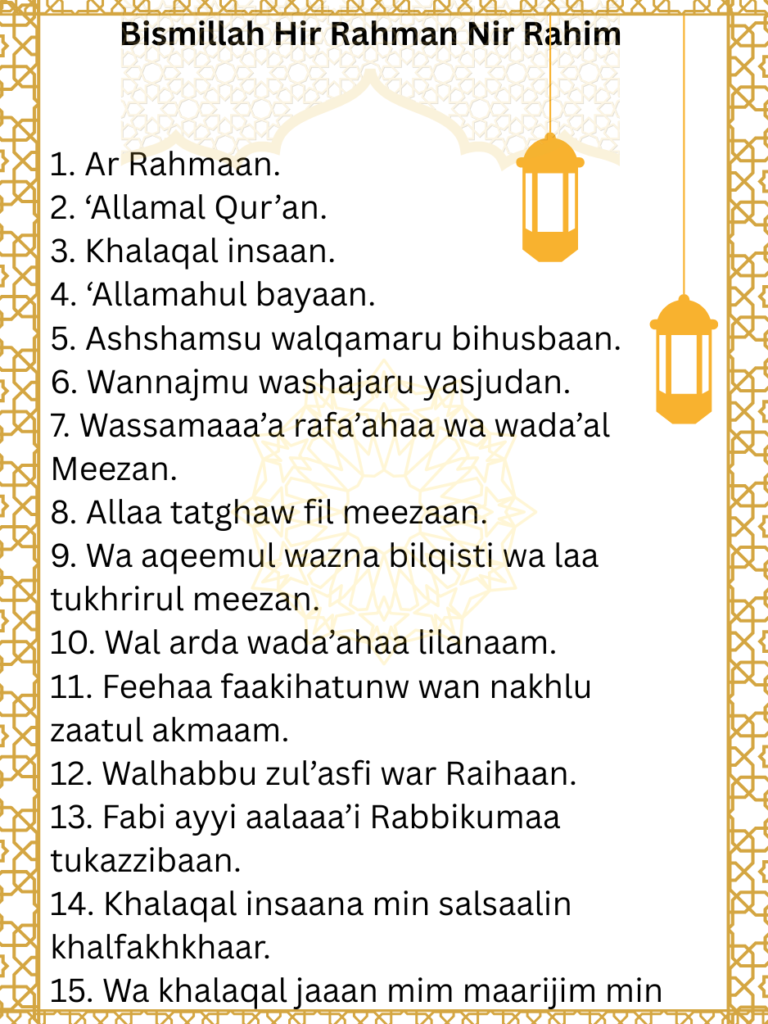
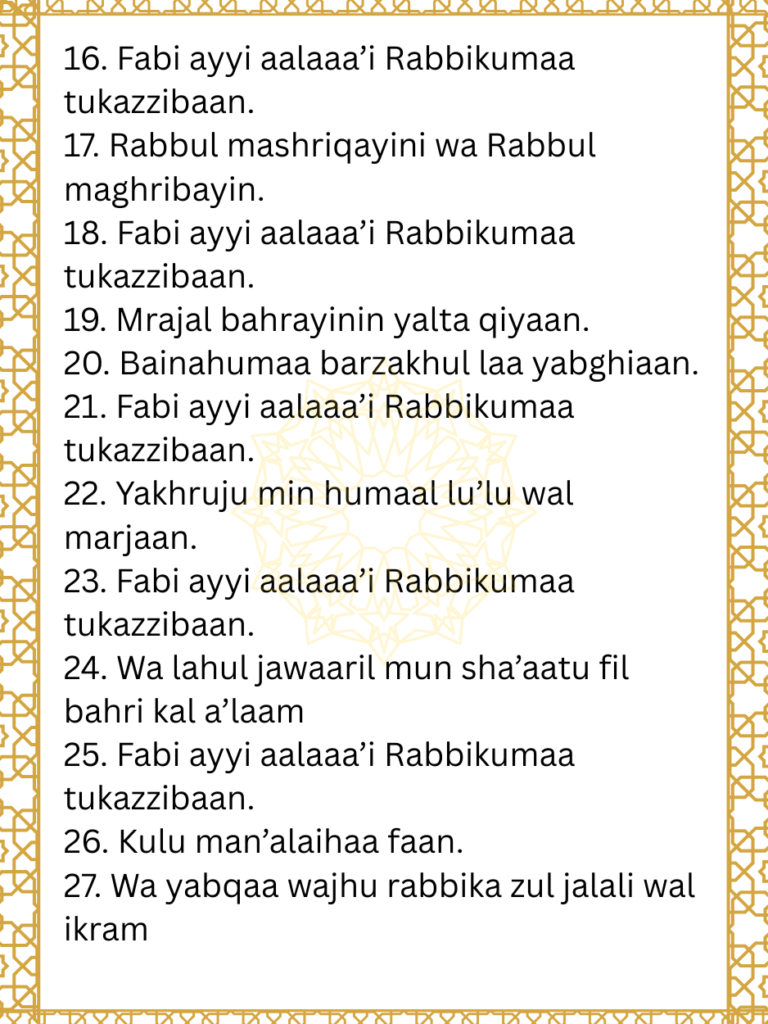
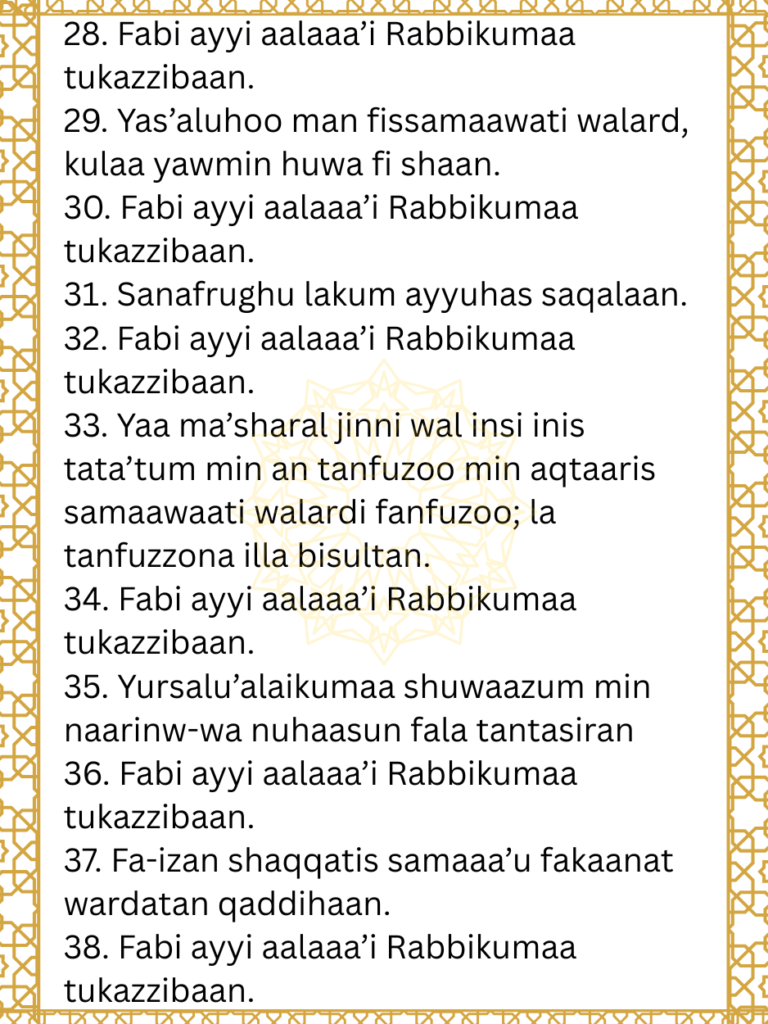
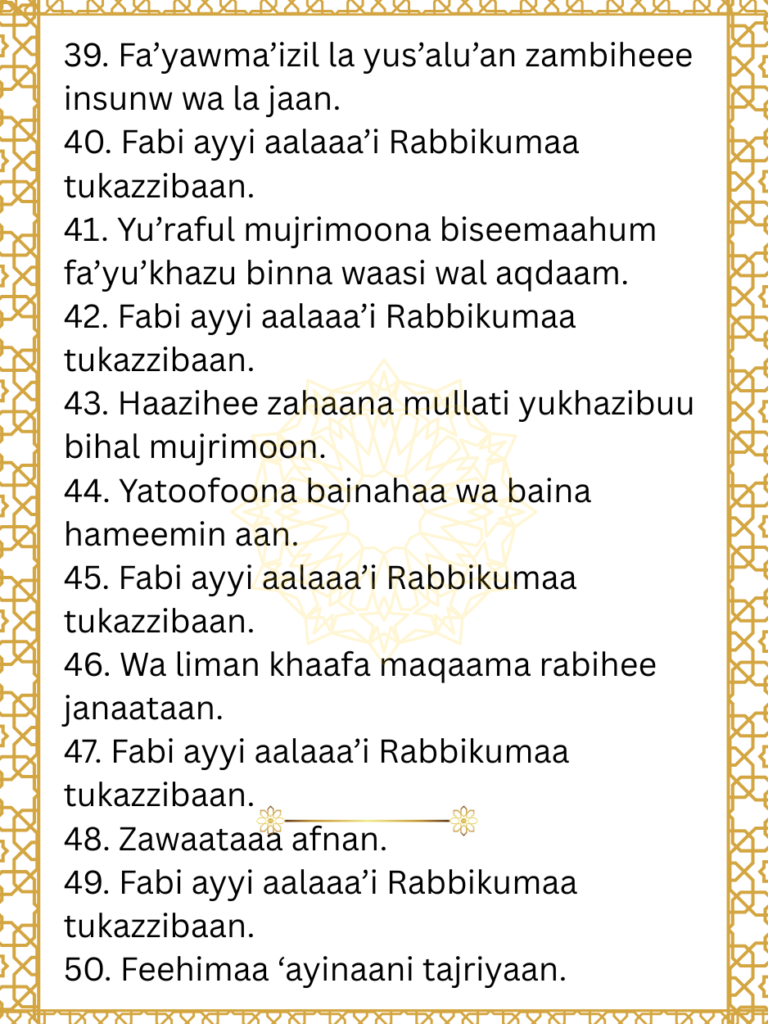
Take the most repeated verse in Surah Rahman, verse 13, which appears 31 times through the surah:
- Pickthall: “Which is it, of the favours of your Lord, that ye deny?”
- Yusuf Ali: “Then which of the favours of your Lord will ye deny?”
- Saheeh International: “So which of the favors of your Lord would you deny?”
- Abdul Haleem: “Which, then, of your Lord’s blessings do you both deny?”
Notice the small but meaningful differences. Some translations use “favours,” others use “blessings.” Some keep the dual pronoun “you both,” reminding the reader that both humans and jinn are being addressed, while others simplify it to a general “you.” None of these are wrong. They are different ways of carrying the same Arabic word, “ala,” into English, and reading more than one translation side by side often gives you a fuller sense of the meaning than relying on just one.
Arabic Words That Are Hard to Carry Into English
Part of what makes Surah Rahman so rich is that several of its key words resist a single, clean English equivalent.
- Ala’ (آلَاء): Usually translated as “favours” or “blessings,” but it carries a sense of visible signs of generosity, not just abstract kindness.
- Mizan (مِيزَان): Translated as “balance” or “scale,” it refers both to the literal act of weighing goods fairly and to the wider cosmic balance Allah has placed in creation.
- Barzakh (بَرْزَخ): Rendered as “barrier” or “partition,” describing the unseen line that keeps two seas from mixing, a concept with no single word equivalent in English.
- Rayhan (رَيْحَان): Often translated as “fragrant plants” or “sweet basil,” referring to pleasant smelling herbs and flowers mentioned among the earth’s blessings.
When you notice a translation footnote explaining a word choice, it is usually because the translator ran into exactly this kind of difficulty.
How to Read Surah Rahman in English More Effectively
- Read more than one translation. No single English version captures every shade of the Arabic. Comparing two or three translations of the same verse, especially around the refrain, will deepen your understanding.
- Follow along with the Arabic, even if you cannot read it fluently. Seeing where the repeated refrain falls in the Arabic text helps you notice the structure of the surah, something that can get lost when reading translation alone.
- Pay attention to footnotes. Translations like Yusuf Ali’s and Muhammad Asad’s include extensive notes that explain historical context, grammatical choices, and classical commentary. These often answer questions a bare translation cannot.
- Read it in sections, not just verse by verse. Surah Rahman moves through clear stages, blessings in creation, a reminder that everything perishes except Allah, a warning about accountability, and a description of Paradise. Reading a section at a time helps the structure make sense.
Choosing an English Translation That Suits You
If you want a translation that reads smoothly in modern English, Saheeh International or Abdul Haleem are good starting points. If you want detailed historical and scholarly notes alongside the text, Yusuf Ali or Muhammad Asad will serve you better. If you are researching how earlier generations of English readers encountered the Quran, Pickthall remains an important and respected reference point. None of these replace the Arabic original, but each one opens a different door into understanding Surah Rahman in English.